
Configuration#
User Settings#
The user identity is managed by jupyter-server and is configurable starting from jupyter-server v2.17.0 and jupyter-collaboration v4.1.0.
To change your username, display name, or color:
Click the Collaboration icon in the left sidebar.
In the User Info section, click your user icon.
Edit your details in the form that appears.
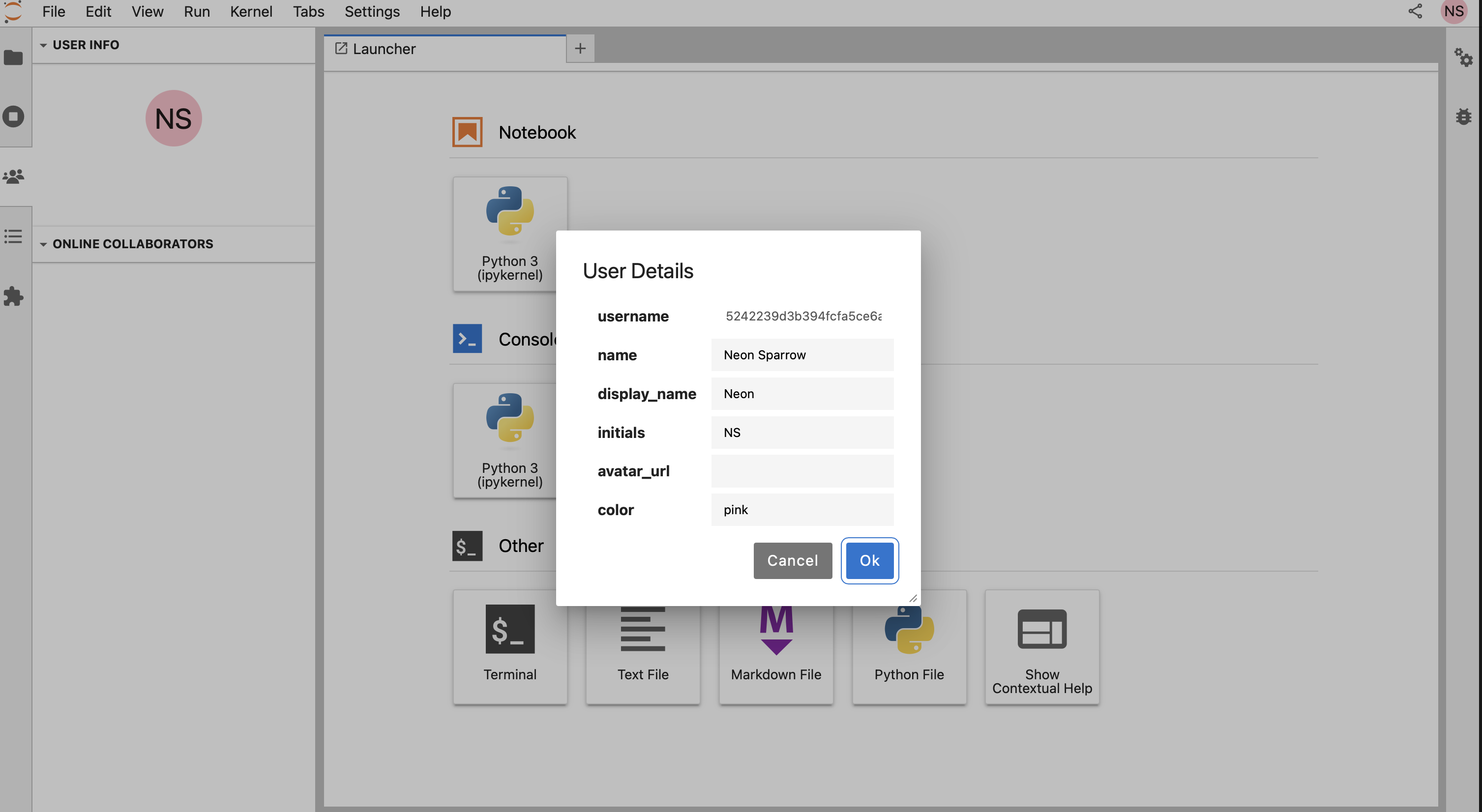
Note: This functionality works only for standalone servers and is not supported in JupyterHub.
Storage Configuration#
By default, any change made to a document is saved to disk in an SQLite database file called
.jupyter_ystore.db in the directory where JupyterLab was launched. This file helps in
preserving the timeline of documents, for instance between JupyterLab sessions, or when a user
looses connection and goes offline for a while. You should never have to touch it, and it is
fine to just ignore it, including in your version control system (don’t commit this file). If
you happen to delete it, there shouldn’t be any serious consequence either.
A second file, collaboration_sessions.json, is created inside a .jupyter directory under
the server’s root directory (ServerApp.root_dir, which defaults to the directory where
JupyterLab was launched). It records recent collaboration session IDs so the backend can
detect when a client is reconnecting after a server restart or version change, and prompt for
a reload when the session can no longer be resumed safely. Like the YStore database, it is
safe to ignore in version control and safe to delete (clients will simply be asked to reload
on next connect).
There are a number of settings that you can change:
# To enable or disable RTC (Real-Time Collaboration) (default: False).
# If True, RTC will be disabled.
jupyter lab --YDocExtension.disable_rtc=True

# The delay of inactivity (in seconds) after which a document is saved to disk (default: 1).
# If None, the document will never be saved.
jupyter lab --YDocExtension.document_save_delay=0.5

# The period (in seconds) to check for file changes on disk (default: 1).
# If 0, file changes will only be checked when saving.
jupyter lab --YDocExtension.file_poll_interval=2

# The delay (in seconds) to keep a document in memory in the back-end after all clients disconnect (default: 60).
# If None, the document will be kept in memory forever.
jupyter lab --YDocExtension.document_cleanup_delay=100

# The YStore class to use for storing Y updates (default: JupyterSQLiteYStore).
jupyter lab --YDocExtension.ystore_class=pycrdt.store.TempFileYStore

# Relocate the YStore SQLite database (default: '.jupyter_ystore.db' in the launch directory).
jupyter lab --SQLiteYStore.db_path=/path/to/ystore.db

# Relocate the collaboration session store
# (default: '<server_root_dir>/.jupyter/collaboration_sessions.json').
jupyter lab --YDocExtension.session_store_path=/path/to/sessions.json
There is an experimental feature that is currently only supported by the Jupyverse server (not yet with jupyter-server, see the issue #900): server-side execution. With this, running notebook code cells is not done in the frontend through the low-level kernel protocol over WebSocket API, but through a high-level REST API. Communication with the kernel is then delegated to the server, and cell outputs are populated in the notebook shared document. The frontend gets these outputs changes and shows them live. What this means is that the notebook state can be recovered even if the frontend disconnects, because cell outputs are not populated frontend-side but server-side.
This feature is disabled by default, and can be enabled like so:
pip install "jupyterlab>=4.2.0b0"
pip install "jupyverse[jupyterlab, auth]>=0.4.2"
jupyverse --set kernels.require_yjs=true --set jupyterlab.server_side_execution=true